If you are evaluating a Hyperliquid historical data API for backtesting, start by sizing the job honestly. Pulling a recent window to inspect by hand is easy. Keeping the same study rerunnable after model changes, incident reviews, or weekly refreshes is where the historical layer starts to matter.
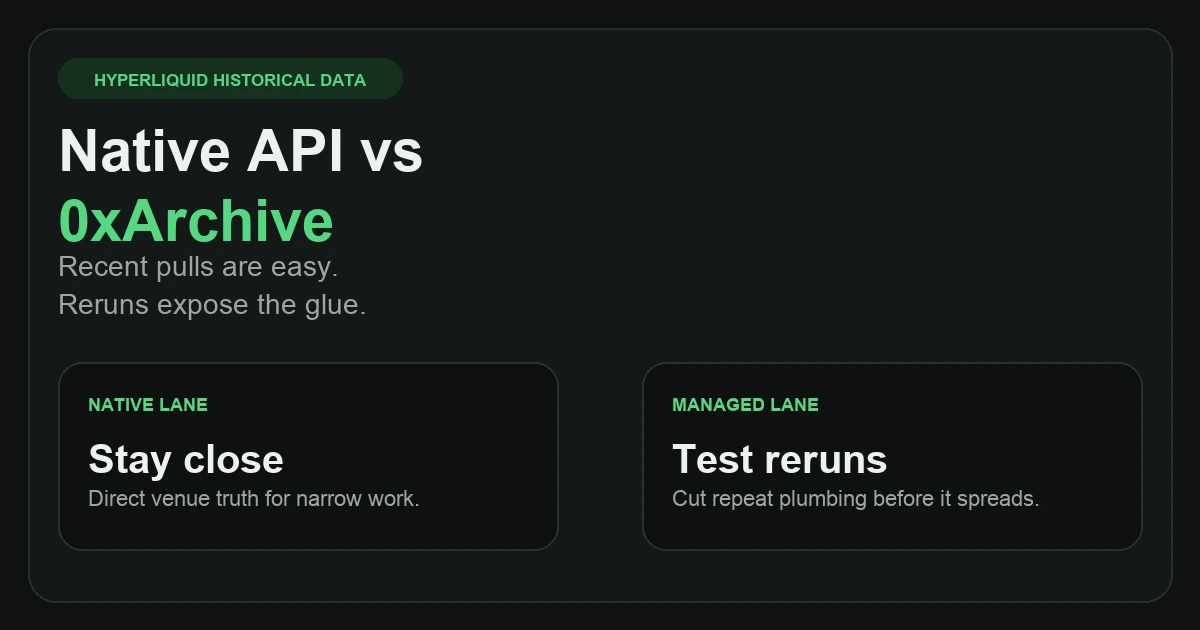
Short answer: use native Hyperliquid when you want direct venue truth, a narrow recent window, and full control over collection. Test 0xArchive when repeated backtests, replay jobs, or order-level studies keep reopening pagination, dedupe, gap checks, replay prep, and rate-limit scheduling. A hybrid setup works well when you want managed history for repeated research and native venue responses ready for disputes.
In 30 Seconds
- Native is enough when you are validating a narrow recent window or debugging venue behavior directly.
- Rerun tax is the real threshold once the same study keeps reopening window walking, overlap handling, gap checks, and replay prep.
- 0xArchive is worth testing when you need published coverage checks, checkpoint history, replay, or deeper order-level routes without rebuilding all of that glue first.
- Hybrid works well when you want managed history for repeated research and native venue responses ready for anomaly checks.
Why this decision matters
This often gets lumped into a generic build-versus-buy debate. That hides the actual cost. A notebook can tolerate some manual stitching. A rerunnable research loop cannot.
Once the same backtest needs to rerun across multiple windows, model versions, or incident reviews, the work shifts from fetching rows to proving completeness, protecting boundaries, and preparing replayable state. That is where hidden rerun tax starts to matter more than the fact that the first request was free.
When native is enough
- You need a recent slice of trades, candles, funding, open interest, or liquidations to decide whether a hypothesis deserves deeper work.
- You are working on one or a few markets, not a recurring research program.
- You want direct venue behavior for live verification or exchange-specific debugging.
- You already own mature collectors, storage, normalization, and replay tooling, so Hyperliquid is only one more input.
That is a credible lane. Hyperliquid native is attractive because it keeps your assumptions close to the venue and the invoice cost at zero. For early research, that can be the right trade.
When a static export is enough
Sometimes you do not need an API loop at all. If the job is a bounded offline study, a static export can be enough. 0xArchive already exposes Bulk Download on the public site, and the live pricing page states Build and Pro include monthly export credits with Apache Parquet downloads. If your study is mostly offline analysis rather than repeated API reruns, that is worth testing before you build more collection code.
Where native starts to cost more than it looks
The first request is rarely the painful part. The pain shows up when the ask becomes “rerun this study reliably every time the model changes.” Hyperliquid’s public docs are explicit about the constraints evaluators have to plan around:
infotime-range responses return at most 500 elements or distinct blocks.userFillsByTimereturns at most 2000 fills per response, and only the 10000 most recent fills are available.- Rate limits specify 1200 weight per minute per IP, a maximum of 10 WebSocket connections, and 1000 subscriptions.
Those limits are workable for exchange access. They do not automatically cover every long-window historical workflow you might layer on top. A 48-hour trade pull is one thing. A six-month rerunnable study across trades, funding, open interest, and replay state is another.
# Representative native long-window burden
cursor = start_ts
rows = []

while cursor < end_ts:
    chunk = get_info_window(symbol, cursor, end_ts)
    rows.extend(chunk)
    cursor = advance_with_overlap(chunk)

rows = dedupe(rows)
assert no_gap_breaks(rows)
replay_seed = rebuild_state(rows)
Native is free in invoice terms. The comparison is about recurring engineering time, rerun reliability, and how much historical plumbing you still own once the work stops being a one-off pull.
What 0xArchive adds to the evaluation
The current public 0xArchive surface is specific enough to inspect directly. The live llms.txt describes two top-level venue APIs, Hyperliquid and Lighter.xyz, with HIP-3 under the Hyperliquid namespace. It also publishes checkpoint history, replay/backtesting support, data-quality coverage endpoints, CLI and MCP access, and order-level routes such as /v1/hyperliquid/orders/{symbol}/flow, /v1/hyperliquid/orders/{symbol}/tpsl, and /v1/hyperliquid/orderbook/{symbol}/l4/history.
- Coverage endpoints let you inspect the historical span before you commit to collection work.
- Replay and checkpoint history let you test whether the historical layer gets you closer to rerunnable state.
- Order flow, TP/SL, and L4 routes let you test deeper market-structure questions without pretending candles answer everything.
- CLI and MCP surfaces let you evaluate the same historical layer inside repeated operator and agent workflows.
Next step: run one-symbol parity
Keep the next move small. One symbol, one historical window, and one study you already know you will rerun will tell you more than a long migration debate.
- Hold the symbol, timestamps, and downstream job constant.
- Measure the second run, not only the first fetch.
- Keep native venue responses as the dispute fallback.
- Run the full parity method here, then come back to the category decision with evidence.
Decision matrix
| Workflow | Native is enough when... | 0xArchive is worth testing when... | Better default |
|---|---|---|---|
| One-off prototype | You need a recent slice and direct venue truth. | You already know the study will become recurring. | Native |
| Static offline study | You only need a bounded export and no rerunnable API logic. | You expect repeat pulls, replay, or follow-on QA work. | Export or native |
| Weekly reruns | You already own strong collectors, QA, and replay prep. | The same backtests keep reopening historical plumbing work. | 0xArchive worth testing |
| Replay workflows | You already rebuild state internally with confidence. | Checkpoint history or replay support may shorten setup materially. | 0xArchive worth testing |
| Order-level research | You already run a mature internal order-history stack. | You need published routes for order flow, TP/SL, or L4 work. | 0xArchive Pro worth testing |
Next steps are simple: run one parity test, keep native in the loop for disputes, and move the highest-friction workflow first instead of migrating everything at once.
Final takeaway
Hyperliquid native is a strong starting point when the work is still narrow, recent, and easy to inspect by hand. Move the evaluation to 0xArchive when historical retrieval starts eating repeatable engineering time that no longer helps the actual research.
Related reads
- How to Run a One-Symbol Parity Test Before You Migrate Historical Data
- When Agent Workflows Need Replayable Market Data, Not Just Raw API Access
- When Checkpoint History Is Enough and When You Need Order-Level Depth